This slideshow requires JavaScript.
Uwe Lessmann of Submatix shows Mark Caney, VP Rebreather Technologies, PADI Technical Diving Division, the recently released Submatix Sidemount CCR and Back-up CCR systems at the Boat Show in Düsseldorf today.
This slideshow requires JavaScript.
Uwe Lessmann of Submatix shows Mark Caney, VP Rebreather Technologies, PADI Technical Diving Division, the recently released Submatix Sidemount CCR and Back-up CCR systems at the Boat Show in Düsseldorf today.
What is RF3 all about?
“The main aim of RF3 is to evaluate the state of the art”, stated Dr. Neal Pollock, DAN’s Research Director and one of the organisers behind RF3. “In a nutshell the theme of RF3 is to improve understanding, which we hope will translate to improved safety across the board.
We’re are going to assess the current situation regarding manufacturing, testing, training and diving protocols to check that we are doing this as safely as we can, and highlight areas that need improving for the community to move forward. We have convened this conference to tap the wisdom of many, rather than relying on the interpretations of any few. Doing it this way allows us to pull together all the different views and we then assess the results through one lens.
The reality is that we still have a number of fatalities every year. At RF3 we intend to be as honest as we can about issues and address every one of them. Most current standards and practices are based on good intentions and experience. The interaction of many factors, however, can create problems not originally anticipated. Our goal is to look critically at the collective to see how we might be able to do things better and safer.”
So why will RF3 be useful to the Industry? When you understand where something is failing; be it manufacturing, training or diving protocols, then everyone benefits from knowing how failures can occur. Then we can see and evaluate how to successfully improve performance.”
You too can be part of this significant rebreather event. Simply log onto www.rf30.org to book your place now. And if you buy your ticket before 1st February 2012 you can save up to $100 on your registration.
This slideshow requires JavaScript.
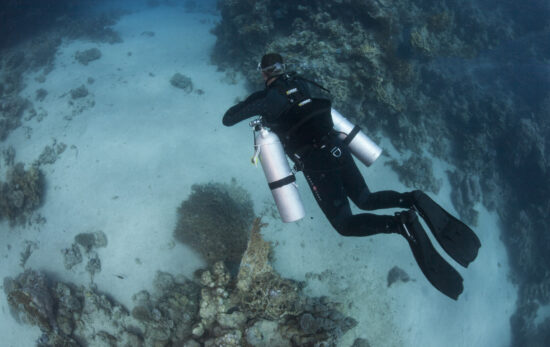
Giving divers a new and alternative way to configure their tanks – Sidemount diving offers an innovative way to streamline in the water, offers easier equipment transportation when topside (instead of hauling double tank configurations around the boat), helps in reducing lower back strain and gives a redundant gas supply.
The PADI Tec Sidemount Diver course along with support materials PADI is renowned for is now available and is currently being offered at PADI Retail and Resort Centers and PADI TecRec Centres globally.
More good news: The long awaited PADI Recreational Sidemount course will be available by the end of March.
Poseidon has announced their 2012 Tradeshow and CCR Training Schedule for the USA and parts of Asia so interested parties can register.
USA (All enquiries and to register follow this link – Poseidon Diving Systems Tradeshows and Events
We hope you had a great start into 2012 and that all your New Year’s Resolutions come true. If those resolutions included picking up a new trade, being more profitable as a PADI Instructor and having a new fun-filled adventure in 2012 we might be able to help. There are a few spaces left for the two upcoming PADI Rebreather and Tec CCR Instructor and Trainer courses in Puerto Galera, Philippines and Sydney, Australia.
Whether you are crossing your current ratings over or you wish to attend the PADI Rebreather or Tec 40 CCR Instructor courses, we have the right programme for you. The Puerto Galera programmes starts on the 7th of February and commences on the 15th of February. The Sydney programmes run from the 18th till the 26th of February. To enquire about the days you will need to attend, prerequisites for the courses and the logistics of each programme please contact tecrec@padi.com.au immediately to avoid disappointment.
Due to the high demand PADI Asia Pacific is scheduling additional programmes in June 2012 in Thailand and Indonesia. Watch this space for further information on dates and venues.
Photo credited to Dr R.Harris
Mark Powell, renowned author of ‘Deco for Divers’, (the award winning guide to decompression theory) and one of the UK’s leading technical diving instructors, has booked his ticket for Rebreather Forum 3. A diver since 1987, Mark has a passion for wreck diving. We asked him why he is attending RF3.
“When Rebreather Forum 2 was held in 1996 it was one of the most influential events in the development of technical diving. I’m therefore expecting RF3 to be even more significant event. The opportunity to get so many divers, instructors, manufacturers and experts together in one place is invaluable. The rebreather industry is at a critical point in its development. Lessons have been learned regarding training, operations and design of units and I expect RF3 to consolidate these lessons and set the direction for the way rebreather diving develops over the next few years”.
What are you looking to get out of Rebreather Forum 3 Mark?
“My main goal is to meet as many people as possible and learn as much as I can. Simon Mitchell is a ‘must see’ as his talks are always entertaining and incredibly insightful and I also want to listen to Jill Heinerth and Richard Pyle. The safety and decompression workshops are the ones I most want to attend and I will definitely be looking forward to the talks by David Doolette, Petar Denoble, Andrew Fock and Bill Stone.
This conference promises to be a lot of fun as well. Whenever divers get together we love to talk and the Beach BBQ Loud Shirt Party on the Friday night sounds intriguing. And if the Gala Banquet on the Saturday night measures up to that at EUROTEK I know we’ll be in for a cracking evening. If you’re serious about your diving, why would you not attend RF3?!”
For anyone with an interest in rebreather technology and science, Rebreather Forum 3 (RF3) is an unmissable occasion. With all the major players attending, this is the perfect opportunity for you to get up to speed with current thinking in rebreather technology, from the industry’s foremost minds.
RF3 (www.rf30.org) will be held from Friday 18th to Sunday 20th May 2012 inclusive at the Caribe Royale Hotel, Orlando. This unique conference comprises two elements; 30 different talks delivered by a team of respected speakers over three days and a specialist Expo with more than 30 international exhibitors.
It’s 16 years since the previous Rebreather Forum and there is much to discuss. Major issues will be addressed surrounding rebreather technology, and its application in sport, military, research and scientific diving. RF3 has two key objectives; an emphasis on safety and the much needed peer review of the state of the art. As a RF3 delegate you will be part of this important process.
The social side has not been forgotten either, whenever divers get together they like to talk and in the up and coming months you can follow us on Twitter; #RebreatherF3. On Friday night there will be a Loud Shirt Party – a Beach BBQ extravaganza – ideal for catching up with friends and colleagues, meanwhile on Saturday night we celebrate success at the RF3 Gala Banquet.
Although rebreather diving is a niche market, it is not without influence and it’s actively expanding. We are now entering a new age of diving. In the last couple of years we’ve seen major steps forward with the recent launch of two recreational machines. The ‘Type R’ rebreather is coming of age and the training agencies are actively working with manufacturers to grow this significant new market.
Attending Rebreather Forum 3 gives you unrivalled access to the very latest in rebreather training, technology and ethos, delivered by some of the world’s significant figures in the field. It’s not often that you will get the opportunity to meet and talk to these cutting edge leading professionals who shape and influence this industry. With tickets starting from US$290, log onto www.rf30.org now to book your place at this decade’s most momentous rebreather event. Regardless of your experience level, Rebreather Forum 3 is not to be missed.
PADI, Poseidon and Worldwide Dive and Sail offer you a chance to win a fantastic Recreational Rebreather package valued at $15,000 US Dollars. Simply go on the Worldwide Dive and Sail website (www.worldwidediveandsail.com) and answer a few questions for your chance to win: a PADI Recreational Rebreather Course and a 10 day luxury live-aboard holiday for 2 people plus receive your own personal Mark VI Poseidon Rebreather to continue your rebreather diving.
Jonas Samuelsson
PADI CD and TecRec Instructor Trainer #72606
What is your background and current involvement in diving?
I started to dive in the Baltic Sea over 20 years ago. During the early 90s I worked as a diving journalist and as an instructor in Scandinavia. In 1997 I became Operational Manager for Ban’s CDC and became PADI Course Director in 1998. I am currently a member of Team Blue Immersion and Dive Team Fourth Element and as a test diver for JS Watch Co. and MOD Lights.
How did you get into tec diving?
While working for a diving magazine I got in contact with Mikael Menduno from Aqua Corps and it was their articles that inspired me to start exploring technical diving.
Do have any specialized areas of interest?
Explorations. Like when we were in Iceland during 2011 found a previously unknown geothermal area and became the first dive team to explore the US Coast Guard Cutter Alexander Hamilton.
What do think the greatest challenges are in this kind of diving?
Exploration is complicated for many reasons. The logistics of getting hold of spare parts and helium in areas where technical diving never been conducted before is not easy. To travel with 100’s of kilo of tech and camera gear to remote areas and to get sponsors to finance the expedition is equally hard. But it’s all worth it.
What are the most important attributes of a tec diver for the type of diving you do?
Patience. I have done the mistake in the past by pushing myself to do dives that I was not ready for and it always ended badly. Progress slowly.
Dedication. It takes both time and money to succeed in technical diving. You need to spend lots of time in the water and you have to keep updated by reading articles and books.
Open-minded. Standardization is crucial, but maintain an open mind to ensure that technical diving will progress. Be willing to listen and learn from others. Technical Diving pioneer Richard Pyle said it best “”After my first 10 hours on a rebreather, I was a real expert. Another 40 hours of dive time later, I considered myself a novice. When I had completed about 100 hours of rebreather diving, I realized I was only just a beginner.”
What are the most likely mistakes a tec diver can make in your kind of diving?
Generally by pushing limits to fast and specifically by not bringing enough gas.
How do you prepare for a demanding technical dive?
By conducting simulation dives in the same configuration to make sure I am mentally and physically prepared. To have the dive plan reviewed by others. To ensure that the support team is ready to manage any emergency. By contacting DAN and the local recompression chamber.
What were your best or worst tec diving experiences?
During one of my first tec dives in 1995 on a wreck in the Baltic Sea when I realized the potential of this new configuration.
I was support diver for two divers who were conducting a dive to 130 meters. I saw a technical diver from another ‘group’ who looked stressed while descending down. I signalled to him asking if all was ok. He signaled back that he was. At the same time the divers I was supporting was in sight and I stayed close to them. Later during that dive my surface team signaled to me that someone had died. The divers I was supporting was next to me so I knew it was not my team of divers. Returning to the surface I got told that the diver I seen had died. My surface team had lifted him out of the water. His gauge showed 150 meters. His certification level was Normoxic Trimix Diver.
What influences your selection of dive gear?
Reliability, simplicity, field tested and service friendly. There are so many other factors that can potentially go wrong in the extreme environments we dive in that you have to be certain that the equipment is reliable. Bring equipment for redundancy and for any potential emergencies, however not more and not less than that. The equipment has to be field tested. It’s one thing of testing equipment in a factory another one to use equipment in the field. The equipment should be easy to service in the field without any specialized tools.
What kind of person do you want diving in the same team as you?
Someone with a high level of knowledge and skills but more importantly a diver with similar attitude as the rest of our team. We are using standardized equipment and a team approach and anyone diving with us has to have that same philosophy to ensure the teams safety. Someone who is professional, safety conscious and able to deal with very stressful situations with calm. Last but not least, it has to be a person that I can have a beer with after the dive.
What advice would you give to someone thinking of getting into tec diving?
Talk to friends and see if they can recommend an instructor that they had a positive experience with. Sign up for a tech intro dive with that instructor and then take it from there. I would like to issue one warning however and don’t come to me in a few years and say you did not know… Technical Diving is highly addictive… You been warned.